

The trading floor is no longer dominated by shouting brokers and frantic hand signals. Today’s markets are shaped by algorithms, machine learning models, and artificial intelligence systems that process millions of data points in microseconds. This transformation isn’t just changing how trades are executed—it’s fundamentally redefining what it means to be a trader in the 21st century.
AI in trading is shifting traders from executors to strategists. Modern platforms like BluStar AI automate execution, risk management, and market analysis 24/7, allowing traders to focus on portfolio strategy and oversight rather than manual order placement and emotional decision-making.
The Evolution From Manual to Algorithmic Trading
The journey from pit trading to algorithmic systems represents one of the most dramatic shifts in financial market history. In the 1980s, traders relied on instinct, experience, and phone calls to execute positions. By the 2000s, electronic trading platforms had emerged, but humans still made the critical decisions. Today, AI-driven systems can analyze technical indicators, news sentiment, macroeconomic data, and order flow patterns simultaneously—something no human trader could accomplish alone.
This evolution hasn’t eliminated the need for human judgment; it has elevated it. Rather than spending hours watching charts and placing orders, modern traders now design strategies, set parameters, and monitor AI systems that handle the tactical execution. The future of investing lies not in replacing human intelligence but in augmenting it with computational power that operates without fatigue or emotion.
What AI Brings to the Trading Desk
Artificial intelligence introduces capabilities that fundamentally change the trading equation. Understanding these advantages helps explain why BluStar trading and similar platforms are gaining traction among both institutional and retail investors.
Continuous Market Monitoring
AI systems never sleep. While human traders must rest, eat, and attend to other responsibilities, automated trading bots monitor markets around the clock. This is particularly valuable in cryptocurrency markets that operate 24/7 and forex markets that span global time zones. A trading opportunity at 3 AM is no longer missed because the trader was asleep.
Emotion-Free Execution
Fear and greed are the twin demons of trading psychology. Humans naturally hesitate during losses and become overconfident during winning streaks. AI systems execute based on predefined parameters without emotional interference. They don’t panic during market crashes or become euphoric during rallies—they simply follow the logic programmed into their algorithms.
Multi-Market Pattern Recognition
Advanced machine learning models can identify complex patterns across multiple assets, timeframes, and market conditions simultaneously. These systems learn from historical data and adapt to evolving market dynamics, recognizing correlations and anomalies that might escape human observation.
Risk Management at Scale
Position sizing, stop-loss placement, and portfolio rebalancing can be optimized through AI algorithms that calculate risk exposure across multiple positions in real-time. This systematic approach to risk management removes the inconsistency that often plagues discretionary traders.
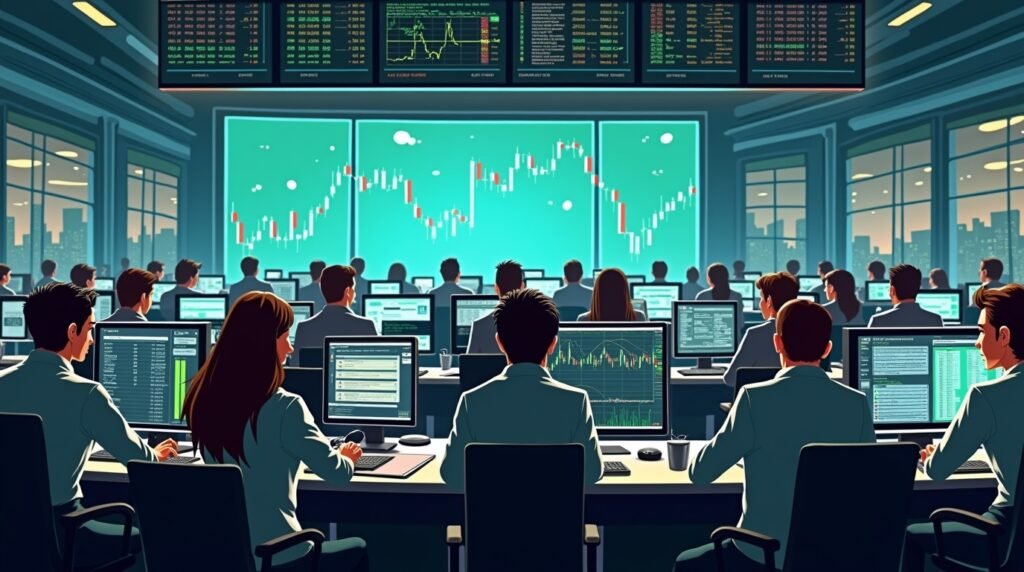
The New Trader Profile: Strategist and Supervisor
As AI handles execution and monitoring, the trader’s role is transforming into something more strategic and supervisory. This shift requires a different skill set than traditional trading demanded.
| Traditional Trader Skills | Modern AI-Era Trader Skills |
|---|---|
| Chart pattern recognition | Algorithm design and parameter optimization |
| Quick execution reflexes | System performance evaluation |
| Emotional discipline | Risk framework development |
| Market intuition | Data interpretation and AI oversight |
| Screen time endurance | Strategic portfolio allocation |
Today’s successful traders understand both markets and technology. They can evaluate the performance metrics of trading algorithms, recognize when market conditions have shifted beyond a system’s trained parameters, and make strategic decisions about capital allocation across different AI-driven strategies.
Challenges and Considerations in AI-Driven Trading
While AI in trading offers compelling advantages, it also introduces new challenges that modern traders must navigate.
- Over-optimization risk: Algorithms can be tuned so precisely to historical data that they fail in live markets—a problem known as curve-fitting or overfitting.
- Black box concerns: Some AI systems, particularly deep learning models, operate in ways that are difficult to interpret, making it challenging to understand why certain trading decisions were made.
- Technology dependence: System failures, connectivity issues, or software bugs can result in unintended positions or missed opportunities.
- Market impact: As more participants use similar AI strategies, the edge from certain approaches may diminish through crowding effects.
- Regulatory evolution: Financial regulators are still developing frameworks for AI-driven trading, creating some uncertainty about future compliance requirements.
Successful implementation of AI trading requires acknowledging these challenges and building appropriate safeguards. This includes regular system audits, maintaining manual override capabilities, and diversifying across multiple strategies and asset classes.
The Human-AI Partnership Model
The most effective approach to modern trading isn’t purely algorithmic or purely discretionary—it’s a partnership that leverages the strengths of both human and artificial intelligence.
Humans excel at:
- Understanding context and interpreting unprecedented events
- Making strategic decisions about overall portfolio direction
- Recognizing when market conditions have fundamentally changed
- Applying ethical judgment and regulatory compliance considerations
- Adapting to completely novel situations without historical precedent
AI systems excel at:
- Processing vast amounts of data quickly and consistently
- Executing trades without hesitation or emotional bias
- Monitoring multiple markets and instruments simultaneously
- Identifying subtle statistical patterns in market behavior
- Maintaining discipline through volatile market conditions
Platforms that embrace this partnership model—allowing traders to maintain strategic control while delegating tactical execution to AI—represent the practical future of investing. This approach preserves human judgment for the decisions where it adds the most value while automating the repetitive, data-intensive tasks where machines have a clear advantage.
Looking Ahead: The Next Decade of Trading
The integration of AI into trading is still in its early stages. As natural language processing improves, trading systems will better interpret news and social media sentiment. As reinforcement learning advances, algorithms will become more adaptive to changing market regimes. As quantum computing develops, optimization problems that currently take hours might be solved in seconds.
For individual traders and investors, this technological evolution creates both opportunity and imperative. The opportunity lies in accessing sophisticated trading capabilities that were once available only to large institutions. The imperative is to adapt—to learn enough about AI and algorithmic trading to evaluate these tools critically and use them effectively.
The traders who thrive in this new environment won’t be those who resist technological change or those who blindly trust algorithms without understanding them. Success will belong to those who develop a hybrid skill set: market knowledge combined with technological literacy, strategic thinking enhanced by data-driven insights, and human judgment augmented by computational power.
The role of the trader is being redefined not by elimination but by elevation. AI handles the mechanical, the repetitive, and the emotionally challenging aspects of trading execution. This frees human traders to focus on what humans do best: strategic thinking, contextual understanding, and adaptive decision-making in the face of uncertainty. The future of investing isn’t human versus machine—it’s human and machine, working together to navigate increasingly complex markets with greater efficiency, discipline, and intelligence than either could achieve alone.
Disclaimer:
Use of this trading system is strictly for entertainment purposes only. Nothing provided should be construed as financial, investment, or trading advice. Trading in financial markets involves a high degree of risk and may result in the loss of your capital. Past performance is not indicative of future results. Automated systems can malfunction or behave unpredictably due to market or technical factors. By using this system, you acknowledge and accept full responsibility for all trading decisions and potential losses. Trade responsibly and at your own risk.