
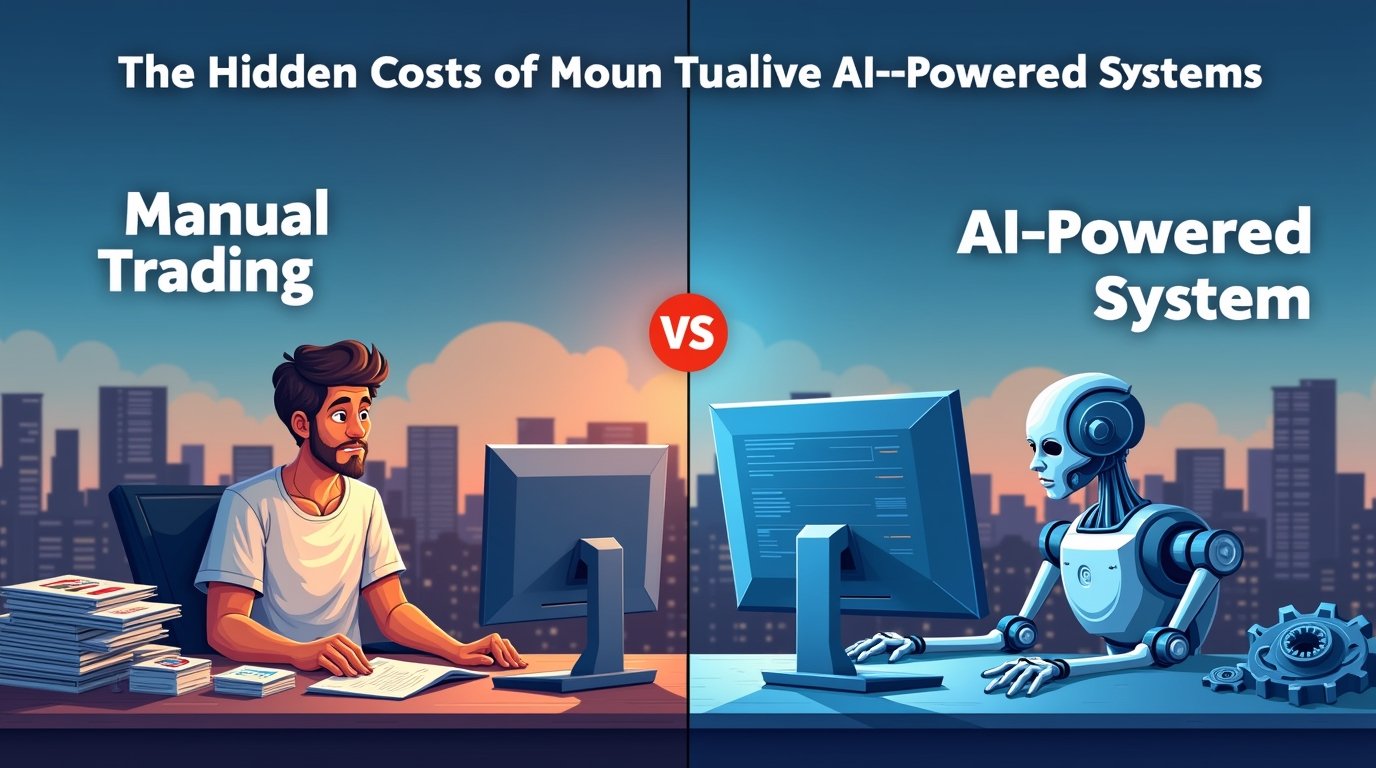
When comparing manual trading vs AI, most traders focus on obvious expenses like commissions and platform fees. But the real story lies beneath the surface. Manual trading carries substantial hidden costs—from opportunity losses and emotional decisions to the sheer time investment required. AI-powered systems like those offered by BluStar AI are fundamentally changing this equation, automating complex decisions and operating around the clock without the psychological pitfalls that plague human traders.
Manual trading typically costs traders 15-30% annually in hidden expenses including missed opportunities, emotional errors, and time value—losses that AI-powered systems systematically eliminate through 24/7 automation and data-driven decision-making.
The True Cost of Your Time in Manual Trading
Time represents perhaps the most underestimated cost in manual trading. Active traders spend an average of 3-5 hours daily monitoring markets, researching positions, and executing trades. Over a year, this amounts to 1,095-1,825 hours—equivalent to a full-time job.
Consider the opportunity cost: if your professional hourly rate is $50, those hours represent $54,750 to $91,250 in foregone income annually. Even if you enjoy trading as a hobby, the time spent away from family, career development, or other investments compounds over the years.
Manual traders also face the challenge of market hours. Forex markets operate 24 hours, five days per week. Cryptocurrency markets never close. A manual trader monitoring Bitcoin must either sacrifice sleep or accept that critical price movements will occur unwatched. The BluStar trading bot eliminates this constraint entirely, executing strategies continuously without human intervention.
Emotional Decision-Making: The Invisible Tax
Behavioral finance research consistently demonstrates that emotions undermine trading performance. Fear and greed drive irrational decisions that erode returns, yet these psychological factors rarely appear on any cost statement.
Common emotional trading mistakes include:
- Panic selling during market dips – Locking in losses during temporary volatility instead of following the strategy
- Revenge trading – Attempting to quickly recover losses through increasingly risky positions
- Overconfidence after wins – Taking outsized positions following successful trades
- Analysis paralysis – Missing opportunities while overthinking entry points
- Holding losing positions – Refusing to accept losses and hoping for reversals
Studies show that emotional decision-making costs the average trader between 3-5% annually in underperformance. For a $100,000 portfolio, this represents $3,000-$5,000 in annual losses attributable solely to psychological factors. AI systems operate without emotion, executing predetermined strategies regardless of market sentiment or recent performance.
Opportunity Costs and Market Inefficiency
Manual traders inevitably miss opportunities. You cannot simultaneously monitor gold, Bitcoin, forex pairs, and equity markets while maintaining the focus required for quality analysis. Each market you ignore represents potential profits left on the table.
Additionally, human reaction times create inefficiencies. By the time a manual trader identifies a pattern, verifies the signal, and executes the trade, favorable pricing may have disappeared. High-frequency movements in volatile markets like cryptocurrencies amplify this disadvantage.
AI-powered systems process multiple data streams simultaneously, identifying correlations and opportunities across markets that would be impossible for individual traders to detect. The BluStar invest platform, for instance, offers specialized bots for different asset classes, each optimized for its specific market dynamics and operating in parallel.
| Cost Factor | Manual Trading | AI-Powered Systems |
|---|---|---|
| Time Investment | 3-5 hours daily | Minutes for setup and monitoring |
| Emotional Errors | 3-5% annual underperformance | Eliminated through systematic execution |
| Market Coverage | Limited to actively monitored assets | 24/7 across multiple markets |
| Missed Opportunities | High during off-hours and across unwatched markets | Minimal with continuous operation |
| Learning Curve | Years of expensive mistakes | Immediate access to proven algorithms |
| Consistency | Variable based on focus and energy | Identical execution quality 24/7 |
The Education and Experience Premium
Developing genuine trading expertise requires years of study and costly real-world experience. Most manual traders pay substantial “tuition” through early losses while learning market dynamics, technical analysis, and risk management.
Professional trading education programs cost $5,000-$50,000, and even then, theoretical knowledge must be refined through practice. The average new trader loses money for their first 1-3 years before potentially achieving consistency. These learning-phase losses often exceed $10,000-$30,000.
AI-powered trading systems encapsulate expertise developed by teams of quantitative analysts and engineers. Users gain immediate access to sophisticated strategies without personally enduring years of expensive trial and error. The algorithms incorporate lessons from millions of historical trades, pattern recognition that would take human traders decades to develop.
Comparing Total Cost of Ownership
When evaluating manual trading vs AI, a comprehensive cost analysis reveals the true financial picture. Let’s examine a realistic scenario for a trader with a $100,000 portfolio:
Annual Manual Trading Costs:
- Time investment: 1,500 hours × $50/hour opportunity cost = $75,000
- Emotional decision-making: 4% underperformance = $4,000
- Missed opportunities (conservative estimate): $3,000-$8,000
- Education and tools: $2,000-$5,000
- Stress and health impacts: Unquantified but significant
Annual AI-Powered Trading Costs:
- Platform subscription: Typically $1,000-$3,000 depending on service level
- Time investment: 50-100 hours for monitoring and optimization
- No emotional trading costs
- Minimized missed opportunities through 24/7 operation
Even without accounting for time value, manual trading’s hidden costs substantially exceed the subscription fees for automated systems. When time opportunity cost is included, the financial case for AI-powered trading becomes overwhelming for anyone whose time has professional value.
Risk Management and Consistency
Manual traders struggle with consistent risk management. After a winning streak, position sizes often creep upward. Following losses, some traders reduce exposure excessively or conversely double down trying to recover. This inconsistency creates unpredictable risk exposure.
AI systems apply identical risk parameters to every trade. Position sizing follows predetermined rules based on account size and volatility. Stop losses execute without hesitation. This consistency protects capital during drawdowns and prevents the catastrophic losses that occasionally devastate manual traders who override their own rules “just this once.”
The Verdict: Calculating Your Personal Trading Equation
The decision between manual trading vs AI ultimately depends on your specific circumstances, but the hidden costs of manual trading are substantial and often underestimated. For most traders, particularly those with valuable professional time and limited experience, AI-powered systems offer superior economics.
Manual trading may remain appropriate for:
- Individuals who genuinely enjoy the trading process as a primary hobby
- Those with extensive experience and proven track records
- Traders whose strategies require discretionary judgment that cannot be systematized
AI-powered systems excel for:
- Professionals who value their time highly
- Traders seeking to eliminate emotional decision-making
- Anyone wanting 24/7 market coverage without constant monitoring
- Individuals who prefer systematic, data-driven approaches
- Those seeking to access sophisticated strategies without years of personal development
The hidden costs of manual trading—time, emotional errors, missed opportunities, and the learning curve—typically far exceed the visible expenses. For traders serious about long-term success, AI-powered systems represent not just a technological upgrade but a fundamental improvement in the economics of trading. By eliminating the invisible tax that manual trading imposes, automated systems allow traders to focus on strategy, risk management, and capital allocation rather than the exhausting mechanics of constant market monitoring.
Disclaimer:
Use of this trading system is strictly for entertainment purposes only. Nothing provided should be construed as financial, investment, or trading advice. Trading in financial markets involves a high degree of risk and may result in the loss of your capital. Past performance is not indicative of future results. Automated systems can malfunction or behave unpredictably due to market or technical factors. By using this system, you acknowledge and accept full responsibility for all trading decisions and potential losses. Trade responsibly and at your own risk.